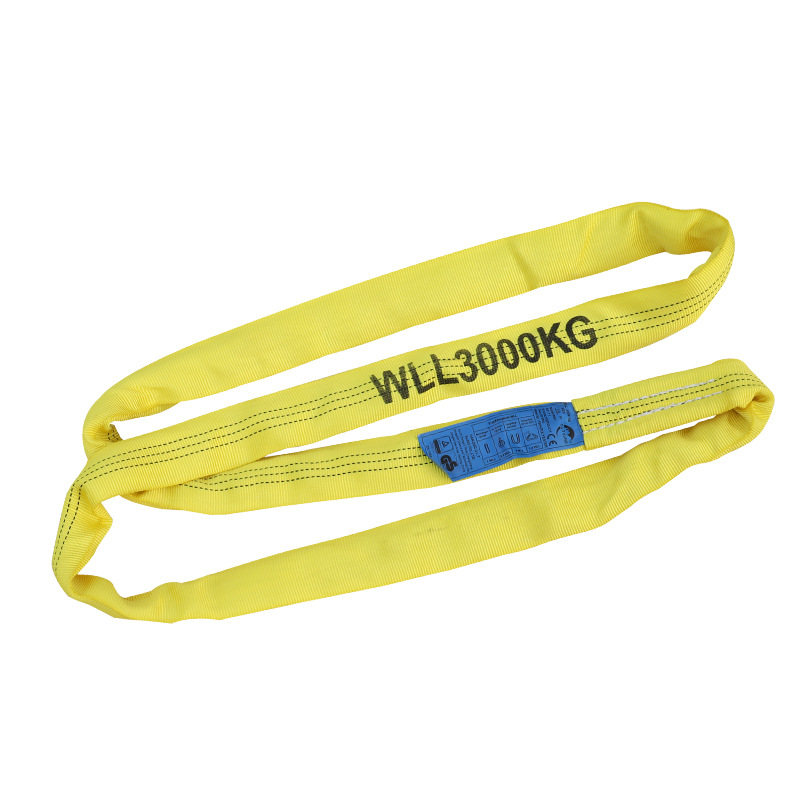
Why Ratchet Tie Down Straps Are Essential for Cargo Transportation
Cargo safety is one of the most important factors in transportation and logistics. Whether transporting machinery, construction materials, containers, motorcycles, or industrial equipment, proper cargo securing solutions help prevent accidents, cargo damage, and financial losses.
Among various cargo securing products, ratchet tie down straps have become one of the most widely used and reliable solutions worldwide. Their high strength, ease of operation, and versatility make them essential in trucking, shipping, warehousing, and industrial transportation.
As a professional cargo control manufacturer, NANJING D.L.T SLING CO.,LTD supplies high-quality ratchet tie down straps for global customers across multiple industries.
What Is a Ratchet Tie Down Strap?
A ratchet tie down strap is a cargo securing device made of high-strength polyester webbing combined with a metal ratchet buckle and end fittings such as hooks.
The ratchet mechanism allows users to tighten the strap securely around cargo, preventing movement during transportation.
Main components include:
- Polyester webbing
- Ratchet buckle
- Double J hooks or flat hooks
- Handle and release mechanism
Ratchet straps are widely used for:
- Truck transportation
- Container cargo securing
- Trailer tie downs
- Motorcycle transport
- Heavy equipment fastening
- Warehouse cargo restraint
Advantages of Ratchet Tie Down Straps
1. Strong Cargo Securing Capacity
High-quality ratchet straps provide excellent tension force and load restraint performance.
Compared with ropes or ordinary belts, ratchet tie downs offer:
- Better stability
- Higher breaking strength
- More secure locking
- Reduced cargo shifting risk
Heavy-duty ratchet straps are especially suitable for industrial transportation and oversized cargo.
2. Easy and Efficient Operation
The ratchet mechanism allows operators to tighten cargo quickly and efficiently without complicated tools.
Benefits include:
- Faster loading process
- Reduced labor intensity
- Improved transportation efficiency
- Safer cargo handling
3. Lightweight but Durable
Polyester webbing offers:
- High strength-to-weight ratio
- Low elongation
- Abrasion resistance
- UV resistance
- Moisture resistance
This makes ratchet tie down straps suitable for both indoor and outdoor transportation environments.
4. Protects Cargo Surface
Unlike steel chains or wire ropes, polyester tie down straps are softer and less likely to scratch painted or delicate surfaces.
This is especially important for:
- Machinery
- Vehicles
- Aluminum products
- Finished equipment
- Sensitive industrial components
Common Types of Ratchet Tie Down Straps
Different transportation applications require different strap configurations.
Popular types include:
- Standard ratchet tie down straps
- Endless ratchet straps
- Cam buckle straps
- Heavy-duty cargo straps
- Auto tie down straps
- Retractable ratchet straps
Common hook options:
- Double J hooks
- Flat hooks
- S hooks
- Wire hooks
- Chain extensions
How to Choose the Right Ratchet Strap
Consider the Working Load Limit (WLL)
Always select a strap with sufficient load capacity for the cargo weight.
Important factors include:
- Cargo weight
- Transportation method
- Tie down angle
- Number of straps used
Check Webbing Width and Length
Common webbing widths:
- 25mm
- 35mm
- 50mm
- 75mm
- 100mm
Longer straps are suitable for oversized cargo and industrial equipment.
Choose Suitable End Fittings
Different hook types are designed for different anchor points and transportation equipment.
Verify Safety Standards
Professional ratchet tie downs should comply with international cargo control standards.
Industries Using Ratchet Tie Down Straps
Ratchet straps are widely used in:
- Logistics and transportation
- Trucking industry
- Construction industry
- Port and shipping operations
- Warehousing
- Agriculture
- Automotive transport
- Heavy machinery transportation
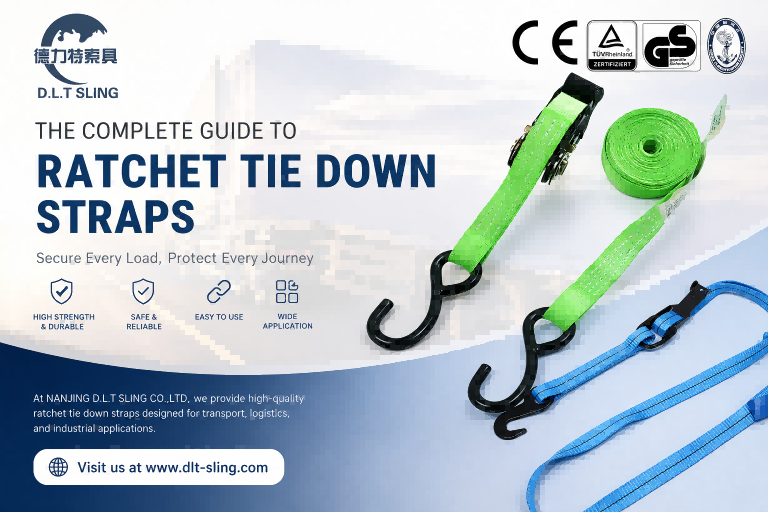
Why Choose DLT Sling?
DLT Sling Official Website is a professional manufacturer specializing in:
- Ratchet tie down straps
- Polyester webbing slings
- Round slings
- Cargo lashing products
- Heavy lifting slings
Our advantages include:
- OEM customization support
- Customized labels and packaging
- CE and GS certified products
- Strict quality inspection
- Large production capacity
- Rich export experience
We are committed to providing reliable cargo securing solutions for customers worldwide.